In the first two articles of this series, I explored transformative participative group processes, what they can make possible and where they can lead into tricky terrain.
In Chasing Coherence, I explored how coherence is not about agreement or harmony, but about an emergent resonance that arises when people are willing to stay with difference and complexity. It is a field quality, not a consensus or a constructed alignment. Coherence appears as an emergent property when a group can hold tension, work with ambiguity, and allow something larger than individual agendas to surface. It is less about fixing or achieving, and more about cultivating the conditions where clarity, insight, and new patterns can emerge.
In The Trouble with Participative Processes, I looked at how easy it is to fall into traps that prevent coherence from forming (belonging traps, fixing traps, drama traps, and others). Participative methods, while powerful, can become self-referential if they overemphasise process for its own sake or shy away from discomfort. True participative work requires courage to stay with chaos and resist premature closure or the urge to control, steer, rescue or heal.
This article now takes a step further. While coherence can be transformative in a contained group setting, scaling that quality into larger collectives or systems requires a different lens. The question shifts from “How do we create coherence in the room?” to “How do we work with the complex, often fragmented landscape of meaning and interaction across a wider ecology?”
After coherence, some ways forward
In the previous articles, I stopped at the threshold of coherence but didn’t explore what happens once a group has landed there.
Coherence, that emergent sense of clarity and flow, is a powerful experience, yet it is not an end in itself. It opens doors. What comes after depends on how the group chooses to continue.[1]
One pathis to take the insights and run with them. The stage of coherence comes with novel ideas about anything you focus the light of sensory clarity on. This is harvest space, easily milked for novelty. Satisfied, you leave inspired, and perhaps, spin out a project, co-found a start-up, or design a new workshop with a few others. You stay in touch, you learn, and you carry this experience with you. This experience stays with you – not just the ideas, but the embodied memory of what’s possible when things truly land. You will always have this feeling reference point. Heads up: this can also spoil you to the point where you can no longer tolerate mediocre facilitation.
Another way forward is to form a community. You have been through a bumpy ride with the others. Judgements have been burnt away, and you realise you actually like those other mad people. You form a team, and something like a community of practice begins to take shape for these methods. You create a common language; you might recruit others. Now, there is another phase shift somewhere along the way: Over time, coherence fades into the background, and a healthy cohesion is mixed in. Other values may take precedence now, like sharing views and being together, like-minded. You start to form habits for how to be together. Over time, this generates familiarity, common values, and shared language. This can create a powerful sense of belonging. Just be aware if it turns sticky.
A third option is to stay in inquiry mode. You have become curious, asking: What else is possible? This means coming back for more process, deeper insight. And this means doing something slightly counterintuitive: disturbing the system again, deliberately.
It doesn’t mean starting over from zero. The group’s ability to navigate the shallows and the traps, their capacity for holding the process despite it and for reaching coherence have already been trained. And still, if you want to keep tapping that deeper field of clarity and emergence, you need to reintroduce difference again. Rattle the stage, reintroduce diversity. Invite different voices, fresh perspectives, and look at other, deeper challenges. Each cycle brings new coherence – richer, sharper, more layered, more fun. Repeat until satisfied. [2]
This is an incredibly rewarding mode. For me, it brought an incredible amount of life wisdom and insights through many group processes – four of them at Alderlore with Bonnie and Mushin – and in the time afterwards in other places, with other groups.
However, on a parallel track, I kept wondering. How can we possibly rely on individual growth or on group processes for wider change?
Beyond the Container into the Wild
All three paths are valid and rewarding in their own right. Yet none of them, on their own, create transformation at scale. They remain bound to the container – the place, the specific group, the shared moment in time. To reach larger collectives or systems, we need to step out of the container and into the wild.
Group processes, as rewarding and powerful as they are, hit their limits when we look toward systemic change. Two major constraints stand out. First, the input costs are high: energy, attention, discipline, and a willingness to engage deeply. Not every context can sustain that. Second – and more fundamentally – group processes don’t scale very well. You can’t simply do such a process in a larger, diffuse collective.
Scaling: From Individual to Group to Collective …
…doesn’t work, at least not linearly.
It’s easy to assume that transformation scales in linear ascension – first the individual, then the group, and then the collective. But this is a false friend. The shift from individual to group already involves a phase change: a group process operates under its own dynamics and logics. Individuals develop, collectives evolve (Roy & Trudel, 2011). Collective change is, by its very nature, an ecological process. They operate by different principles.
You can’t add up individual transformations and expect a system to shift. This, along with the developmental bias, remains one of the most persistent misunderstandings in the change field and in many leadership programmes: the belief that a) change works linearly, in a mechanistic way, and that b) collective transformation is just the sum of changed individuals. [3]
A few years ago, while exploring the German and Swiss markets, I interviewed with a company in the car manufacturing sector. They asked how I would allocate 100 consultancy hours for a merger. I laughed, refusing to step into the obvious trap of a reductionist answer. Later, they called:
“Mrs Caspari, you see change as a process?”
“Yeeees…?”
“Then we can’t work with you.”
The next shift, from group to collective, is different again. A contained group has clear boundaries, a shared container, and curated conditions. The trust generated in a group process, the coherence-as-emergent-property of a well-held group can’t be rolled out by widening the scope to include a whole team, department, company, or neighbourhood.
Scaling change requires a different lens, one that can work with the rich, complex, fragmented landscape beyond the contained room. The logic of a wider collective is ecological in a different sense – it requires working with patterns, flows, and attractors rather than with structured processes or shared intentions.[4]
Landscape ecologies
The ecological approach has been the common thread in my work for nearly four decades: tracking the deeper substrates and systemic patterns that shape how things grow, connect, or come undone.
In landscape work, the starting point is always the current conditions and their potential for rewilding or harvesting – the soil, the exposure, the existing biodiversity. In human systems, the substrate and site conditions are more abstract, but the principle holds.
The starting points and boundary conditions of larger collectives are fundamentally different from those of a group coming together to explore processes. A larger collective is diffuse. People come and go. They participate with varying levels of attention and commitment, and most of life happens in between the moments of gathering.
This is why, for example, the popular “law of two feet” in open space formats can sometimes be counterproductive to coherence or emergence, when participants simply leave when things get uncomfortable.
Moreover, in departments, organisations, neighbourhoods or cities, there is rarely a meaningful common denominator in terms of direction, unarticulated needs or explicit wants. The often-invoked pillars of “shared values” or “purpose” may be helpful, if they are allowed to show up as emergent properties, but are usually too coarse, too abstract or too prescribed to function as genuine common ground.
We are dealing with a richly textured and detailed ‘landscape of attitudes’, that includes convictions, behaviours, fears, frustrations, ideas, goals, and ways of making meaning – all shaped by the complexity, ambiguity, and tensions of everyday lived experience.
This diversity is not a problem; it’s what makes a system adaptive. But it does mean that rather than focusing on scaling up what works in small groups or with large top-down change initiatives, we might begin to look beneath the surface, to the underlying conditions that give rise to patterns of behaviour, resilience, or stuckness in collectives. [5]
Reading the landscape through sense-making
To tend to a human ecology, we must first learn to read it. This is what we learned from Dave Snowden and his work, a thought leader in the field of applied complexity science and, luckily for us, a friend and mentor. His work introduced us to sense-making and anthro-complexity as vital ways to engage with change in larger collectives.
What first intrigued me about his work was this: when we ask differently, when we invite people to share descriptive accounts of their own lived experience, everyone can contribute. It opens the door to genuine collective sense-making. No one needs to be trained, changed, developed or told to change their values. This resonated with my growing discomfort around the question of scaling and the pervasive developmental bias we noticed alongside Bonnie (Roy) and Mushin (J. Schilling) in much of integral thinking.
Sense-making, at its core, is how people orient themselves in the world – how they assign meaning to everyday experience in order to act. In complexity, it’s not about gaining full clarity. It’s about making just enough sense to make the next best step.
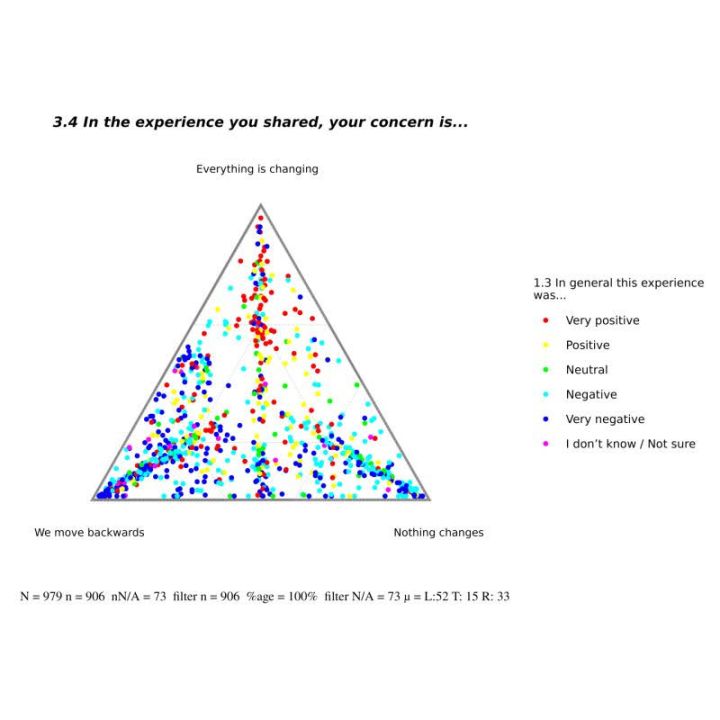
Dave’s methods of distributed ethnography, supported by the SenseMaker app, help us stay close to what is actually happening in the system. By collecting micro-narratives – short, self-interpreted stories – we gain a textured map of lived experience across a human system. These fragments of frustration, insight, tension, or possibility, told and qualified in the language of those who live them, form a real-time understanding of the collective landscape.
SenseMaker® enables the gathering of large volumes of such narratives across diverse contexts. These fragments don’t produce abstract conclusions but reveal a textured, fine-grained “landscape of small noticings”. Within that landscape, patterns begin to show: emerging themes, tensions, outliers, and coherence forming in unexpected places.
We then use these narrative-based maps to design small, localised action portfolios. These are interventions that are not imposed from outside but respond directly to the contextual realities revealed by the stories. These actions can be tested safely, enabling us to learn with the system what is already working and what isn’t, long before committing resources to larger-scale initiatives.
Rather than generating a fixed plan, this gives us a strategic view made up of many local, contextualised action portfolios. These are not top-down interventions but small, adaptive responses and experiments that can be tested safely in context. They help us learn with the system what is already working, what isn’t, and what might need to shift before committing to broader change efforts.
Over time, these small moves can shift constraints, alter interactions, and change conditions in ways that make new behaviours possible, without requiring any personal transformation. These openings are what we call “adjacent possibles” – areas of movement that exist just next to what is currently real.
What emerges is not a master plan but a strategic map of many contextualised action options. These interventions can shift constraints, conditions, or interactions in ways that allow new attractors to form and new behaviours to emerge – without requiring people to “change” in the conventional sense. We call these next-step opportunities within current realities the adjacent possibles.
This invites a different kind of inquiry:
What are people’s underlying, often unarticulated needs (not opinions)?
What patterns do we want more of? What is unexpected or surprising?
Which patterns might we dampen or disrupt?
Where is something already working, and how could we support it?
As Dave puts it: “What can we do tomorrow to have fewer stories like those – and more like these?”
This kind of mapping doesn’t aim for agreement or alignment. It’s about tracking where energy is gathering and adjusting accordingly. It opens up concrete possibilities, with small actions that can be strengthened, paused, reversed, or withdrawn. What emerges is a living picture of how and where to move next.
Change as the Sum Total of all Micro-Shifts
Small, rich interactions
Change does not happen by aligning everyone to a single plan, but through countless small interactions – in how people pay attention, engage, and participate differently.
People don’t change by being told what to become; they change when the nature of their relationships shifts. Change happens when the relational field around them shifts, when conditions change, when familiar patterns begin to lose coherence and when new patterns of behaviour begin to make more sense than the old ones. Change also takes root when the new path is less costly – socially, emotionally, or economically, when energy gradients are favourable.
Beneficial coherence
In complexity work, we don’t set fixed outcomes or goals. Instead, we describe the current terrain in enough fine-grained detail to see where movement is already possible – where energy is gathering and where people are open to something new.
From there, we make small, contextual nudges that support beneficial coherence – the spontaneous alignment that forms around local attractors.
Fun fact: Trying to go “holistic” with this approach makes little sense. No one can hold all viewpoints at this level of granularity. Nor should they. Nature itself optimises without any central intelligence or complete knowledge of the whole. This is about cultivating the conditions for a system to respond, adapt, and self-organise. It’s a landscape ecology approach to change.
The role of granularity
Dave Snowden’s playful example of how to organise a children’s party illustrates this beautifully: success doesn’t come from a rigid plan but from setting enabling constraints and responding in real time to what emerges.
Coherent change arises from the micro-level – from the fine granularity of real interactions, not from big-picture frameworks. Most change programmes misunderstand this. They operate at too abstract a level, missing the subtle shifts that actually move the system. But when we pay attention at the right level, to the interactions themselves, we start working with what’s genuinely generative.
Two years ago, we watched a large, costly cultural change project for leaders in a manufacturing company fail like the 23 initiatives before it. The new metaphor they chose for the culture change was “systems engineering.”
Learning from Nature
Nature offers plenty of examples: swarms, rhizomes, and mycelial networks all create order without central control or grand design. Termite mounds, for instance, emerge from countless local interactions – the final shape can’t be specified or engineered. Coherence shows up as regularities in recurring patterns, which can then be supported or amplified.
Emergent patterns must be spotted early. This is what determines whether a given vector – the directional momentum of change – is favourable or needs adjustment (Vector Theory of Change).
Micro-shifts all the way down
In complex systems, interactions, not individuals, are the smallest coherent units.
Change becomes visible, often in hindsight, as the cumulative effect of many micro-shifts of interactions in the relational field. These shifts are subtle adjustments in attention, expectation, or behaviour. They are contextual and non-linear. Sometimes they build gradually; sometimes they hit a tipping point, reshaping the whole field. Like changes in soil composition, they alter what can grow.
This approach propagates change through two mechanisms: amplifying beneficial patterns and disrupting entrenched assemblages. Recombination occurs between these local interactions. System-level shifts arise when enough micro-shifts begin to entangle and cohere.
This is where scaling begins. Using SenseMaker®, we can map a narrative landscape across a large collective with the necessary fine granularity. We then work with the system, following what is already moving instead of forcing what can’t be moved. This saves energy and reduces resistance.
We’re not trying to yank the system in a predetermined direction, but reading its current disposition and nudging where it is ready to shift. This makes change more sustainable, resilient, and elegant – and often far more affordable than top-down initiatives.
In this view, scale doesn’t come through replication or linear rollouts but through ecological responses. Dave Snowden summarises this well: “In a complex adaptive system, scaling works by decomposition to the smallest coherent unit and then recombination.” Think of how organic matter decomposes and becomes part of new life, or how DNA propagates. More mycelium than gears or cogs.
References & Links :
Baeck, Ria (2020): Collective Presencing: An emergent human capacity. Self-Published E-Book.
**This is the third of a series of three essays that Anne has contributed to Emerge over the last two months as part of our exploration of coherence in the context of the Erasmus+ research project Cohere+. In the Cohere+ project, we have used the SenseMaker App to determine if and when groups are falling out of coherence. This article appeared first here: Whatisemerging.com Pictures by Anne & Anna Caspari.
NOT ALL GROUP PROCESSES LAND IN COHERENCE. And even when they do, not all of them stay there. Many lose it on the way, and some never quite touch it at all. After our group process — the initial one in Alderlore and the ones that followed over the years, as described in the first article of this mini series of three — we began to notice that the same kinds of traps, diversions, and coping strategies showed up again and again, even among the most skilled and well-intentioned participants.
Before we dive into the juicy parts in this second article around transformational group processes, here is a small recap of the distinction between cohesion and coherence that we found helpful:
Cohesion is more about sticking together. It keeps a group within certain social boundaries. Often, this is wanted and helpful for creating communities around a special topic, practice or place. It can foster a sense of belonging, but also an us inside vs. themoutside group dynamic that, in its toxic forms, can even lead to cult-like characteristics. Sometimes it can be suffocating. A group can be cohesive without being coherent; the reverse is true, too.
Coherence, in this context, means something quite different. It’s the quality that emerges when people, ideas, and ways of thinking resonate – like an orchestra in tune. It can’t be forced. It often appears only after moving through real chaos, silence, and letting go of control. Coherence isn’t something you design or impose upfront: it arises through interaction and shared sense-making within the right conditions and constraints.
So let’s dive into where things tend to go wrong.
1. The Authenticity Trap
After the first Alderlore experiments, and as we began to name what really happens in group processes, we started joking: “The authentic self walks into a bar…”
The first in a series of three essays on coherence and group processes
I HATE GROUP PROCESSES.
I’m an introvert by nature. As an empath, I feel a multitude of things all at once, but I’m not great at translating what I sense on the spot. Group processes tend to overwhelm me. I sense the tensions, the awkwardness, the intentions, but also the power-moves. At the same time – damn – when a group lands in real coherence, it can be incredibly rewarding.
Back in 2013, after an Integral Theory Conference in the US, a group of friends and I were frustrated with the ‘developmental agenda’ and were inspired to do things differently. With my friends Mushin Schilling from Berlin and Bonnitta Roy from Connecticut we came up with an enticing idea: let’s meet with a group of people who are also curious about what a group process can do, with not much of an agenda, not much structure, and little to no facilitation. Let’s look into finding new answers, new questions.
We’d invite the right people. People who’ve done their homework. Integral thinkers who understand complex concepts. Change practitioners who’ve been around the block. People who can differentiate between schools of thought, take multiple perspectives and distinguish between the self and the experience the self is having in this moment.
Wouldn’t it be fun to get this much “horsepower” – intellectual, spiritual, relational – in one room and see what we could come up with as a group? Our intention: exploration into the power of group and process. We were after new ideas – and, ultimately, new categories of ideas.
So we met at Bonnie’s place in Alderlore, Connecticut, USA as a group of twenty curious people from all over the world. For three days, we stabbed at the beast, not even knowing what kind of beast it was. We let the process loose on itself. Just before we were ready to admit failure, on the afternoon of day three, the process gelled and we got somewhere. Up until that moment? Pure agony. My worst nightmare confirmed.
2013 Gathering at Alderlore
What I’d never experienced before: my body picking up all the incongruencies, tactics, pretence and power moves in the room as pain. Worse, it was a transpersonal pain, so I couldn’t even do “own it away”. All I could do was mirror it back to the group, like a weather report. Pain, interest, confusion, searching, exploring, confusion, pain, anger, more anger – relief.
We finally got to a place of real coherence, despite all our best efforts to get there. We threw everything at it: willpower, exercises, “follow my lead”, appeals to “come from Source”, desperate attempts to create coherence, power moves, withdrawal, theory downloads, emotional outbursts, complaining, chanting, facilitation, no facilitation. Looking back, all of it just prolonged the process.
Most people left on Monday. My friend Mushin (Mushin Schilling) and I stayed with Bonnie. We had to know what the hell hit us. We had the best intentions. No priming, no heavy-handed facilitation, brilliant people in the room. So why did it go so wrong for so long?
Digging into the process during the 2013 gathering
Over the next few days, we did the most generative digging, the best post-mortem ever. We went deeply into the nature of group processes, exploring emergent properties such as coherence and what actually enables insight to emerge. So much became clear in hindsight, things we just couldn’t see in real-time. Still today, I draw on the emerging wisdom from those days with Bonnie and Mushin.
Here are some of our findings.
Group processes have distinct phases
We saw the typical phases of a group process (outlined in more detail in Cohering the Integral We-Space: A We-Space Ecology):
Politeness – The phase where social conventions rule, and everyone avoids conflict.
Authentic chaos – The rebellion against politeness. Social dynamics and power plays surface, people get uncomfortable, and the lack of structure starts to bite. Attempts to fix or facilitate the chaos too soon only drag it out (see also Scott M. Peck).
Silence – A moment of surrender. The burnout after trying to control the process. A really strange and new space. Willingness to let go of the purpose. Feels like failure.
Authentic clarity – The fog begins to lift. It starts with sensory clarity—the social self steps back, and boundaries blur. An extraordinarily ordinary space. This can deepen into emotional, intersubjective, and conceptual clarity. This is where coherence starts to set in.
Emergence – From clarity, new insights and possibilities arise organically.
The dust settles
One thing has become obvious: emergence and full participation don’t happen without navigating the authentic chaos phase. The only way to navigate it is going through it, hopefully with as little resistance to the inherent discomfort as possible. Efforts to skip, short-cut or over-control this phase leads tend only to prolong the chaos phase. Smart facilitation of the “rapids” (such as trying to smooth out resistance, explain concepts to the group, offering to heal somebody who seems hurt, have a meditation because there is too much tension or even aggression in the room) all leads to a much shallower process, or a predictable outcome colored by the facilitator’s preference and the facilitation techniques used. In these scenarios, nothing truly new emerges.
The most rewarding stages of the process are indeed when the dust settles and clarity sets in. There are no filters anymore of any kind – sensory, cultural, conceptual, or emotional. All have been “burned out” in the endothermic chaos phase. This is the most extraordinary, clear space to sit in with others. Paradoxically, this is, at the same time, the most ordinary space ever, since you see things just as they are. It is filterless. There is no perceiving or acting through any identity: the ‘body-mind drop’. It is extraordinary only because we hardly ever spend time in this clarity.
In our case, the sense of coherence was palpable for the first time. Language and grammar shifted, pronouns moved from I to it, to we. I’d felt that kind of coherence before in nature, in a forest, hanging out with animals, with family, with close friends – but never like this, in a group of strangers.
Combined with that clarity, it felt like a crack wide open, the one where the light gets in. Light in the form of new ideas, new perspectives, new concepts. One feels unobstructed by anything already ‘known’, by resistance, by pattern entrainment. It’s a truly innovative space, and it feels like a blessing.
This is the exquisite context you can milk for ideas and in which you can witness emergence in real-time. Ideas are born, not from brainstorming or clever frameworks, but from the depth and resonance of shared clarity. The filters – emotional, conceptual, cultural, sensory – are gone, or, if there, at least in service to something greater than the individual.
And now, in that rare clarity, we can drop any question into the resonant field: how to address climate change on a regional level? What about monetary systems? Organisational stuckness? Polarisation? Artificial intelligence? We can feel the group orient around the question, not from opinion, not from theory, but from a kind of collective seeing.
The diversity in the room – people from all walks of life, cultures, disciplines, and continents – now becomes a real asset. It nurtures a kind of holographic intelligence. We’re no longer talking at each other or over each other. The filters have dropped. The signal is clean.
In this space, we can tap into – for lack of a better word – mass consciousness. We begin to sense how the world works, what solutions are crystallising, and what might be wanted tomorrow. It’s extraordinary and exquisite: a shared capacity to recognise things as they are.
Start-ups are born here.
What’s next?
Just as the dust settled and clarity set in, another set of questions emerged. If coherence is so elusive, yet unmistakable when it arrives, how do we tell it apart from other group phenomena? From cohesion? From just feeling good together? From processes that seem to work, but actually short-circuit what wants to emerge?
What followed was a deeper inquiry which looked not only at what worked but at the traps we fall into: mistaking structure for substance, method for meaning, or cohesion for coherence. The next essay will take you into some of these finer distinctions – some messy, ambivalent, but also necessary to name if we care about true emergence. Stay tuned.
(Bonnitta was host for several group sessions over the years at her retreat center in Alderlore, Connecticut, USA. Our first encounter was in 2012. Bonnitta hosts Collective Insight Practices for groups who are experimenting with new ways of being)
**This is the first of a series of three essays that Anne will contribute to Emerge over the coming weeks, as part of our exploration of coherence in the context of the Erasmus+ research project Cohere+.
This article was first published here, curated by Leigh Biddlecome
‘I LIKE A GOOD THEORY, BUT IN MY HEART I’M A PRACTITIONER. In a spiritual and practical sense, the theory needs to work on a Monday morning, a Thursday afternoon, and at the end of the day in the marketplace.’
As part of our ongoing series of profiles as part of the Cohere+ research group, today we’re publishing a wide-ranging interview with Anne Caspari, condensed and edited from several conversations I had with her over the last few months. What struck me was her deep experiential knowledge of the field going back over two decades, and her pathway into this work through environmental science and policy, applying her understanding of complex ecological systems to group transformation processes.
We will be publishing a series of essays by Anne over the coming weeks on the subject of creating containers for change in larger collectives, and how we might shift from a developmental bias to prioritising ‘micro-shifts’ and complexity theory.
In the meantime, dive into our conversation to learn more about her sense of coherence as a quality of ‘falling into place’ experienced in nature. Towards the end, we arrive at a more nuanced exploration of coherence and cohesion; shifting from the more common characterisation of these respective states as ‘positive vs negative’, she describes a contextually-dependent, dynamic cycle between ‘inquiry mode’ and ‘business mode’. There’s much more, including around our shared experience of ‘sensor networks’ of social coherence in Italy, how she entered the field of adult development while living in Rome, and what it taught her about how to introduce these concepts in various cultural contexts.
– Leigh Biddlecome
Leigh Biddlecome: What have you been thinking most about today?
Anne Caspari: Many things! Actually, I would say my basic mode is feeling, and my second mode is thinking. So if anybody asks me ‘what do you think about that?’. I need to check in with my feeling modality. And then I have 125 perspectives on a topic within a couple of seconds….I can then hopefully translate that into what I’m thinking about a subject.
But to answer your question, of course, there are the upcoming German elections. What’s going on in that field is amazing, to put it neutrally. I’m also thinking a lot about what we’re working on right now with political projects, using complexity methods and sense-making.
LB: The first time we spoke, alongside my colleague Ivo J. Mensch, I was really drawn to your descriptions of what it has been like to inhabit these ecosystems from the ‘fringe,’ as you put it. Can you describe any particular experiences in which you’ve felt outside or counter to dominant forces within group settings?
AC: What I learned early on is that I don’t feel well in the middle of a group. I sense more through my body than through anything else and if there’s stuff going on that is not coherent, not congruent or not ‘clean’ in a moral sense, my body picks that up, and I don’t feel good.
When I was very young I thought that there must be something wrong with me, because, you know, everybody wants to be part of a group, and I didn’t. This started in kindergarten and then in high school with all the social bonding going on in a context of 36 girls. It’s not that I didn’t have friends, but I felt there’s something deeply not okay with the dynamics of in- and out-groups. I probably couldn’t play the game. So early on I had a hunch that what we now would call cohesion can be kind of dangerous. In German it’s called Gruppenzwang, a kind of forced ‘groupiness’.
And that sense perpetuated, So when I started working with groups as a coach and with consciousness training, I learned how to see this not as something wrong with me but rather that I could actually use this quality, as a kind of a transpersonal phenomenon.
Let’s call it another word that I don’t really like, but it’s hypersensitivity. There’s the sensitivity in the subtleties that I actually could pick up on to feed it back into the group and say, ‘Look, there’s stuff going on here…’ Without even needing to name it, that was already helpful sometimes. So I could feed this impression back to a group and then it started being actually a really cool thing, a generative move to say, look, ‘Can we all be aware of what’s going on here? What is it? Can we overcome it? Can we integrate it?’
LB: How and when did you enter into the field of (broadly speaking) adult development?
AC: This was back in the early 2000s, I was living in Rome at the time working in the environmental sector and got started with a set of practices that – well, back then you didn’t have a word for coaching, but I’d say it was a kind of consciousness training.
It was deeply practical, asking questions of you like, ‘How are you getting in your own way and not seeing it? How are you projecting out and not seeing it? How are you inviting people to sabotage you?’
This article was originally published in Paul van Schaik’s Urban Hub 21: Coming of Age – Dare to Dream (2020): It can be looked at here (pages 82ff), or bought here. Download the article here.
The crisis of confusion
Two of the major crises of our time, Covid-19 and climate change, are indicators of the general failure of our globalized, co-dependent and fragile systems Collectively, we are in a phase of deep uncertainty. At the moment, it seems that our own interests contradict each other on many different levels of our work and personal life. We have a hard time balancing our basic values while it seems that work is pitched against health, health against freedom, economic interests against survival, young against old, ethics against pragmatism. We are in an unprecedented crisis of confusion: we are unable to process what is happening around us sensibly in real time in order to be able to act.
Nowhere is this a multiple Crisis of Sensemakingmore evident than in our cities. Existing pathologies and systemic issues are magnified, like in the case of an uproar in domestic violence, the fact that the elderly in their homes can’t be visited, or worse, have to die alone. New fault lines show themselves between privileged and not privileged, being able to keep distance or in having access to a garden or not.
At the same time, the current crisis offers historical chances to allow new habits, new rituals, new ways of dealing with each other in our relationships, economies, and ecologies. Some cities, like Amsterdam, are talking about adopting different approaches to value chain and city management (doughnut economics). Experts estimate that through the obligatory working in home office and the resulting push in innovation in telecommunication on the one side and trust on the other side, between 15 and 30% of office retail space in our city centres will be obsolete in the near future, which would open up other possibilities for housing etc. New stories are emerging, both utopian and dystopian at the same time.
Banksy
Whatever happens, it will have an impact on the way we live together, on the urban fabric, the city scape, our co-living space. Any attempt to cocreate a new generative direction consciously, in its best integral sense, must start with paying attention to the phenomena that are actually happening right now, to the overall felt sense of confusion on the one hand and collective sensemaking on the other, especially when people are overwhelmed by the ambiguity inherent in current developments. Fears, worries, contradictions, values, new ideas, frustrations, shadows, wishes and desires live here, on this level, right now.
So, what if we listened deeply? What if we could access the high dreams and the low dreams, the fears, concerns, ideas, trends, signals coming from the system, the early warning signs for changes that are currently taking place or those that are overdue? What do people tell each other about how they experience and understand the crisis? And of course: how can collective change take place on this basis? How can a new,meaningful narrative be created here.
Die zwei großen Krisen unserer Zeit, Covid-19 und der Klimawandel, sind Indikatoren für das generelle Scheitern unserer globalisierten, abhängig und zerbrechlich gemachten Systeme. Gleichzeitig zeigt sich die Politik nach wie vor in der Versuchung, Komplexität und Unsicherheit mit unzulässiger Vereinfachung, Verflachung und Gewissheitsversprechen zu begegnen.
Die Krise der Verwirrung
Kollektiv befinden wir uns in einer Phase tiefer Verunsicherung und Verwirrung. Im Moment scheint es, dass sich unsere eigenen Interessen auf vielen verschiedenen Ebenen unseres Arbeits- und Privatlebens selbst widersprechen. Wir müssen zwischen unabdingbaren Grundwerten abwägen, und es scheint, als stünde Arbeit gegen Gesundheit, Gesundheit gegen Freiheit, Aktivismus gegen Ökologie, Wirtschaftsinteressen gegen Überlebenschancen, Jung gegen Alt, Ethik gegen Pragmatismus.
Es handelt sich nicht so sehr um eine kollektive Identitätskrise, wie sie beispielsweise bei der Flüchtlingsthematik in Deutschland aufkam. Diese aktuelle Krise geht tiefer; es ist eine multiple Sinnkrise, sie betrifft jede und jeden, betrifft alle Aspekte unseres Seins. Und damit nicht genug: Haben wir einen Sinn gefunden, entgleitet er uns gleich wieder. Etwas, das in einem Kontext Sinn macht, bewirkt im nächsten Kontext das Gegenteil. Soziale Distanz als notwendige Maß-nahme auf der einen Seite lässt auf der anderen Seite zu, dass alte, kranke Menschen allein sterben. Die aus Sicht der Pandemie sinnvolle Distanz kostet durch die Unterbrechung globaler Werteketten möglicherweise ein Vielfaches an Menschenleben durch Hunger und andere sekundäre und tertiäre Folgeerscheinungen. Wir stecken in einer nie vorher dagewesenen Krise der Verwirrung: Wir schaffen es nicht, das, was um uns herum geschieht, in Echtzeit sinnvoll zu verarbeiten, um handeln zu können.
Dieser Crisis of Sensemaking[1][2] sind wir, sind unsere Politiker derzeit nur unzureichend gewachsen. Neue Politik, im besten, integralen Sinne, muss lernen, auf die Phänomene rund um Verwirrung auf der einen, und Sensemaking auf der anderen Seite zu achten, insbesondere wenn Menschen von der den Entwicklungen innewohnenden Mehrdeutigkeit überfordert sind. Hier, auf dieser Ebene, wohnen die Ängste, Sorgen, Widersprüche, Werte, Ideen, Frustrationen, Schatten, Wünsche und Begehren. Werden sie nicht gehört, suchen sich diese Energien Auswege, die mittlerweile allzu bekannt sind.
Was also, wenn man einmal wirklich, tiefer, hinhören würde? Was sind also die Ängste, Sorgen, die Ideen, die Trends, die aus dem System kommenden Signale, die Frühwarnzeichen für gerade stattfindende oder nötige Veränderungen? Was erzählen sich die Menschen darüber, wie sie die Krise erleben und verstehen? Und natürlich: wie kann auf dieser Grundlage kollektive Veränderung erfolgen? Wie kann hier ein neues, sinnvolles Narrativ entstehen?
What do we need to know to develop good decision-making for both normal and complex conditions?
Despite the importance, impact and frequency with which we make decisions in our private and professional lives on a daily basis, the actual process of making a decision is surprisingly unknown to us. And that is the case, whether the decisions are made in normal or under complex conditions. Many people just don’t know how to do it: making good decisions.
For many people, decision-making is more like a process of guessing or betting on a result, be that what they eat in a restaurant to choosing a job or investing in the stock market. Many even inform themselves, ask the right questions, but when it comes to act of the actual decision, they muddle through, decide somehow, and hope for a good result.
The Black Box
From cognitive science (and here: Dave Snowden), we know that people make decisions through a way that is called “conceptual blending”: Being faced with a decision we scan only about 5%-10% of the information available and then do a first fit pattern match (not a best fit pattern match) with multiple fragmented memories in a subconscious process. This process, where we assemble some knowledge, blend in some memories, – especially the recently activated ones – leads then to a unique course of action, that often defies logic and insight. Since most of the time we are not aware of these processes, we have come to label this black box process “intuition” or “gut feeling”.
When asked about the actual decision-making process that other people could coherently follow, even senior leaders tend to a list of actions rather than coming up with a comprehensible process. People also often invent a story according to which the decision makes sense afterwards. It is strange that this story depends heavily on the result of the decision: if you were successful, the decision-making process is told very differently than in the case of a failure. Cognitive scientists call this phenomenon of experiencing or describing a decision as good or something that made sense in hindsight “retrospective coherence” – also not really a reliable process.
Entscheidungsprozesse sind weitgehend unverstanden
Gemessen an der Anzahl an Entscheidungen, die wir tagtäglich in unserem Privat- und Geschäftsleben treffen, ist es erstaunlich, wie viele Menschen gar nicht wissen, wie das geht: gute Entscheidungen treffen.
Entscheidungsfindung gleicht für viele Menschen mehr einem Prozess des Ratens oder des Wettens auf ein Ergebnis, angefangen von dem, was sie in einem Restaurant essen, bis hin zur Auswahl des Jobs oder dem Investieren an der Börse. Viele informieren sich auch, stellen die richtigen Fragen, aber wenn es zur eigentlichen Entscheidung kommt, schummeln sie sich durch, entscheiden irgendwie und hoffen auf ein gutes Ergebnis.
Werden Menschen nach dem Entscheidungsprozess befragt, listen auch hochrangige Führungskräfte eher eine Liste an Aktionen auf, als einen nachvollziehbaren Prozess zu nennen. Auch erfinden Menschen oft eine Geschichte, nach der die Entscheidung im Nachhinein irgendwie Sinn ergibt. Kurios ist, dass diese Story stark vom Ergebnis der Entscheidung abhängt: Hat man Erfolg gehabt, wird der Entscheidungsprozess ganz anders erzählt als bei einem Misserfolg. Dieses Phänomen, eine Entscheidung im Nachhinein als stimmig zu erleben, nennen Kognitionswissenschaftler ‚retrospektive Kohärenz‘.
Meistens wird angenommen, dass ein positives Ergebnis eines Entscheidungsprozesses automatisch bedeutet, dass ein guter Prozess genutzt wurde. Dies ist nicht unbedingt der Fall. Dass oft dem Ergebnis eher als dem Prozess Gewicht verliehen wird, ist nicht in unserer Gesellschaft nicht ungewöhnlich, in der Fehler im Ergebnis abgestraft werden. Wenn jedoch der Prozess selbst nicht solide ist, wird das Lernen aus den Fehlern schwierig, die Intuition wird nicht geschult, und den Faktoren Zufall und Glück wird größere Bedeutung eingeräumt als ihnen zusteht.
Der beste Weg zu einer guten Entscheidung ist tatsächlich ein solider Entscheidungsprozess (Russo & Schoemaker: Winning Decisions):
Ziel und ‚Framing‘: das allgemeine Ziel des Entscheidungsträgers, einschließlich der Art und Weise, wie er über das Wissen nachdenkt, auf das er seine Entscheidung stützt;
Ein realistischer Ansatz zum Sammeln von Informationen;
Entscheiden: Informationen organisieren und verschiedene Perspektiven abwägen;
Ein Ansatz zur Kommunikation und Umsetzung der getroffenen Entscheidung;
Lernen aus Erfahrung, einschließlich einer Möglichkeit, die Wirksamkeit einer Entscheidung zu messen, damit Anpassungen vorgenommen werden können
Nun stellen sich dem Entscheidungsträger noch weitere Herausforderungen: Je nach Komplexitätsgrad oder Unsicherheitsfaktor sehen diese Schritte nicht nur anders aus, sondern unterliegen ganz anderen Gesetzmäßigkeiten.
The trouble with decision making (DM) as a topic is its complex character which is doesn’t lend itself well to unpack it in a linear modality. For as soon as we want to dive further into our process, we have to determine first which domain we are finding ourselves in: an ordered domain or a complex one?
Most people seem to conflate #risk with #uncertainty. However, risk can be calculated by algorithms and described by probability in stochastics. Whether that is the probability of winning or losing at the casino or the risks of flying an airplane under normal conditions.
With uncertainty, all bets are off. The outcome cannot be known or calculated. Both conditions require very different approaches to decision making. The best decision under risk is not the best decision under uncertainty.
Interesting added dimension: DM researcher @Gerd Gigerenzer states that with high uncertainty and unstable conditions, with only little data available but many variables, experienced experts do better relying on their (trained!) #intuition or simple #heuristics rather than trusting complicated algorithms and calculation models as DM support. Novices should instead train their intuition first before relying on it. And for anything that can be calculated (risk), algorithms can help. Most DM researchers argue for a good mix of the use of intuition and formal decision making support.
In the last blog I ended with establishing a baseline around decision making, drawing on the Lectical Decision Making Assessment (LDMA) and Russo & Schoemaker (“Winning Decisions”):
Framing: the general goal of the decision maker including the way they think about the knowledge upon which they base their decision
A realistic approach to gathering intelligence
Coming to Conclusions: organising and analysing the information and a way to coordinate different perspectives (weighing)
An approach to communicating and implementing the decision made
Learning from Experience, including a way to measure the decision’s effectiveness so adjustments can be made
It seems that already the first step, Framing, is much undervalued, or even overlooked. The way we frame a problem exerts enormous control over the options we recognize, the data we collect and the solutions we choose.
Poor framing can lead people to sensible-sounding but fundamentally limited views of the world to structure their decision making process. According to Russo & Schoemaker (“Winning Decisions”), we experience frames when we meet people who just seem to immediately understand us. Or in the frustration of trying to talk with others who just don’t seem to get it, no matter how much we try to explain. Cognitive scientist call these different ways of looking at the world “frames”. They are mental structures that simplify and guide our understanding of a complex reality. Everyone must inevitable adopt some kind of simplifying perspective.
With the amount of decisions that we make every day, it is astonishing that the process of making decisions is not well understood. So how do we make the best choice?
The very act of deciding seems a bit like the piece of soap in the bathtub: the more you want to get a grip on it the more it slips away. Much is talked today about VUCA conditions, and decision-making in complex adaptive spaces with highly uncertain outcomes, volatile ingredients and complex relationships are a different animal all together to deal with. Many leaders that we worked with, when asked to portrait their decision-making process in a way that it could be followed or repeated by others, tend to come up with a list of actions rather than a solid decision-making process. That made us curious. We ventured more into the terrain of choice-making.
The weird thing is that even in ‘normal’ conditions people are not aware of how they make choices. Some people pose their questions attentively, gather relevant information superbly and then “wing” it with the actual act of deciding. And then come up with a perfect explanation in hindsight.
So, starting to establish a baseline around decision making, let’s consider basic steps, drawing on the Lectical Decision Making Assessment and Russo & Schoemaker (Winning Decisions):
Framing: the general goal of the decision maker including the way they think about the knowledge upon which they base their decision
A realistic approach to gathering intelligence
Coming to Conclusions: organising and analysing the information and a way to coordinate different perspectives (weighing)
An approach to communicating and implementing the decision made
Learning from Experience, including a way to measure the decision’s effectiveness so adjustments can be made
Outlook: In some next blogs I intend to bring in more and more layers of decision making, exploring input from different topics, authors, influenzers and frameworks: Dave Snowden, Gary Klein, Bonnitta Roy, Gerd Gigerenzer, Andy Clarke; Lectica.org; concepts/models/ methods: Framing, Cognitive Biases; Intuition; Sensemaking; Cynefin Framework, OODA Loop, Risk vs. Uncertainty, Heuristics, Constraints, Learning, Failure, Innovation, Theory of Change….
This is a recent interview conducted by Joanne Wood for a partner organisation Rise Beyond, UK:
A conversation with Anne Caspari
Anne is a specialist in transformative processes and change, for both personal and leadership development. With a MSc/MPhil in Ecology and Environmental Development from Hannover University, Germany, she draws on three decades of experience with complex systems, adaptive pushback and obstacles to self-organisation. This knowledge, combined with more than 18 years of work on adult development (developmental coaching) and transformation gives her a unique edge. She works with teams and groups to tap into what is actually happening, uncovering obstacles and pushback in the business ecology and setting free team intelligence and alignment.
Jo: I would love to get an idea of what your focus is on at the moment.
Anne: We are focusing on both personal transformation and organisational change. And on the interfaces between both. For personal transformation we run courses at our retreat centre. The people who come are already quite aware of their patterns, just not sure how to integrate them. Some of them are also coaches and change professionals. What do they want to work on? It’s different for everybody, it could be in a job, money, relationship, health, something you are doing to keep you in a certain place, and you are sick and tired of it.. We work with them on the capacity to find these patterns, resolve the underlying resistance and the ability to deal with whatever it is, to be with what you normally push away into either the subconscious or outside of yourself. For example this could show up as blaming everyone else for triggering your anger.








 Die zwei großen Krisen unserer Zeit, Covid-19 und der Klimawandel, sind Indikatoren für das generelle Scheitern unserer globalisierten, abhängig und zerbrechlich gemachten Systeme. Gleichzeitig zeigt sich die Politik nach wie vor in der Versuchung, Komplexität und Unsicherheit mit unzulässiger Vereinfachung, Verflachung und Gewissheitsversprechen zu begegnen.

 Der beste Weg zu einer guten Entscheidung ist tatsächlich ein solider Entscheidungsprozess (Russo & Schoemaker: Winning Decisions):


You must be logged in to post a comment.