

Sensemaking
Sensemaking, simply put, is the process through which people give meaning to their collective experience. It helps individuals understand what is actually happening in their environment, rather than what they think is happening or wish it were. In practice, it means paying close enough attention to lived experience to act on it well.
It’s particularly valuable in complex and unpredictable situations, where conventional approaches — detailed plans, technical expertise, or “predict and control” strategies — fall short, including in what’s often called a VUCA world (volatile, uncertain, complex, and ambiguous).
The Cynefin Framework distinguishes between problem domains that call for different kinds of response; complex adaptive systems are exactly the domain in which technical solutions alone aren’t enough.
With the right tools, we can better understand how people within organisations perceive their leadership, their relationships, and their daily interactions. This collective intelligence provides authentic, real-time, contextualised data that organisations can use to address current challenges and uncover emerging trends and ideas. In our view, this approach holds potential well beyond organisational development — it applies to community engagement, governance, environmental and climate work, refugee response, leadership development, and project evaluation.
In organisational development and coaching, the key is to work with what is actually happening, not what should be happening — to understand what people are really telling their colleagues, friends, and partners about their work. Drawing on Dave Snowden’s work, we focus on three things:
- We make it easy for people to tell small stories that show what is really happening in the organisation — about attitudes toward change or safety, about problems, challenges, or trends, about the way things actually get done.
- SenseMaker®, a tool built for exactly this, captures these stories and searches them for trends, challenges, and the organisation’s actual disposition toward a given topic — change, leadership, safety, collaboration. Snowden calls this mapping the current dispositional state of the organisation.
- The organisation, or a department, can then be nudged toward the next generative step. The guiding question is: “What can we do tomorrow that gets us more stories like these, and fewer stories like those?”
This approach is relevant and elegant because it works with people and situations as they actually are. It assumes employees know their jobs and understand what’s going on, good and bad — tapping into the ‘organisational gold’ of lived experience without requiring large-scale change initiatives, mindset shifts, or lofty goals. By working with stories and the systems they reveal, organisations can surface culture, values, and behaviour in a natural way, engaging with what is actionable, meaningful, and generative in the present moment.
Image: Banksy
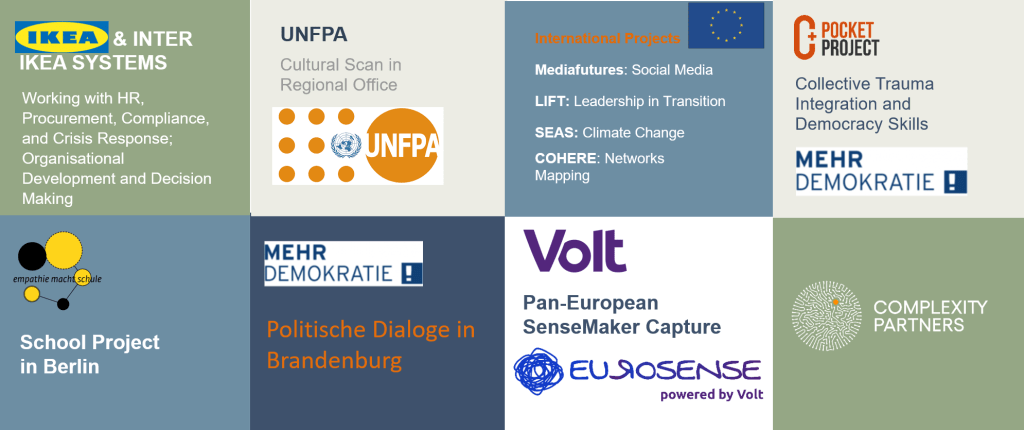
Some client cases with the use of the SenseMaker App:
Pingback: Collective Change Processes: Driving Development, Scaling Change |
Pingback: Driving development vs scaling change | MindShift